
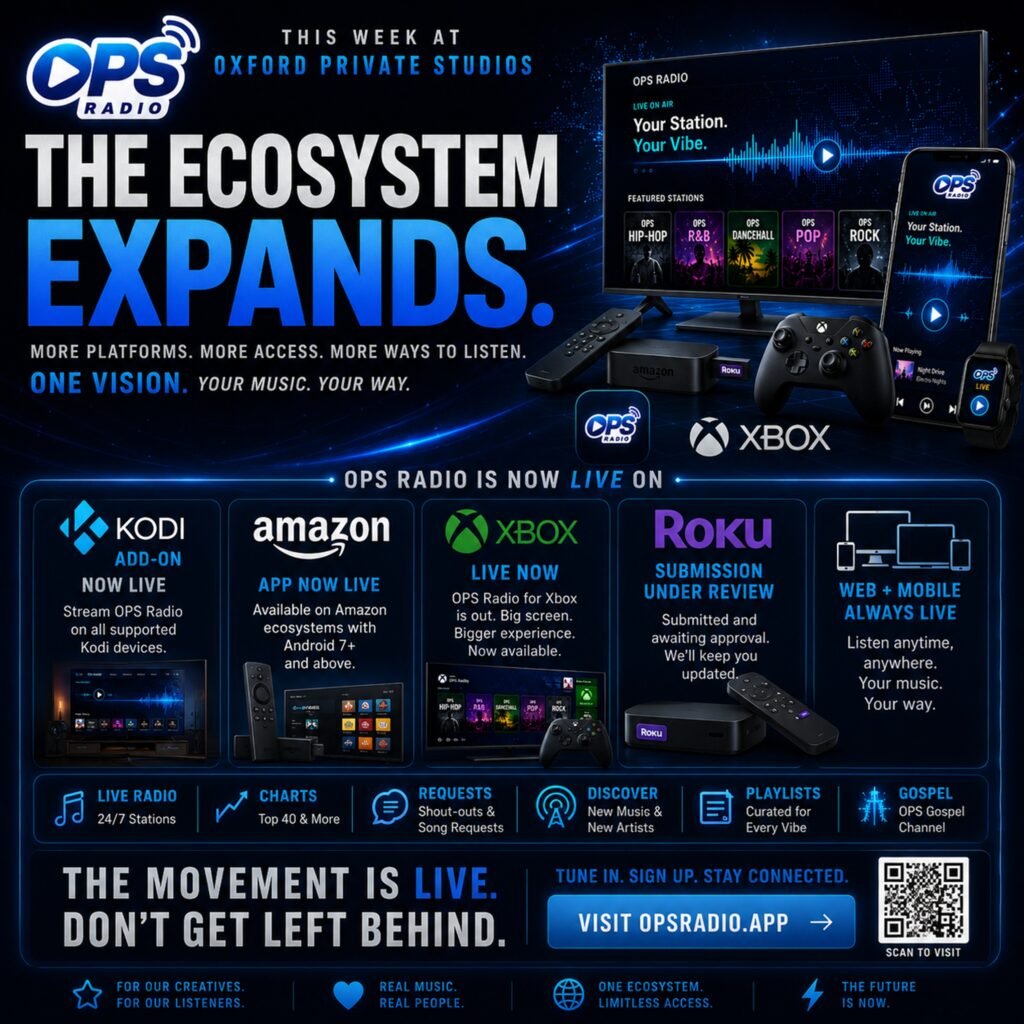
Oxford Private Studios says its focus is increasingly shifting toward platform ownership, distribution independence, and long-term sustainability for creatives, as OPS Radio continues expanding across new devices and ecosystems.
Over the past week, the company has launched its Kodi add-on, expanded onto Amazon-supported Android ecosystems, continued Xbox development, and submitted OPS Radio to Roku for approval as part of a wider push into television and living-room media platforms.
The developments mark one of the clearest signs yet that Oxford Private Studios is no longer positioning itself solely as a music label, but as a broader media and technology ecosystem designed around artist visibility, direct audience engagement, and platform control.
KODI ADD-ON NOW LIVE
One of the most significant developments this week is the official launch of the OPS Radio Kodi add-on.
The add-on is now live across supported Kodi-compatible devices, allowing listeners to stream OPS Radio directly through home entertainment systems, television-connected environments, and media-center setups.
For Oxford Private Studios, the launch is being viewed internally as more than a technical release.
It is part of a wider strategy aimed at making OPS Radio accessible wherever audiences choose to consume music.
“People no longer experience radio through one device,” the company said internally during development discussions earlier this year. “Music now lives across televisions, phones, consoles, tablets, browsers, and connected ecosystems. OPS Radio has to meet listeners where they already are.”
The Kodi rollout allows users to access live stations, discover OPS artists, and engage with the wider catalogue through larger-screen experiences increasingly associated with modern streaming culture.
AMAZON APPSTORE EXPANSION CONTINUES
Oxford Private Studios has also confirmed that OPS Radio is now live across Amazon-supported ecosystems compatible with Android 7 and above.
The launch brings the application into Amazon-connected device environments, further extending the platform’s reach into smart television and home media spaces.
The company says the expansion forms part of a deliberate strategy to reduce dependence on traditional music distribution pipelines and to strengthen direct platform ownership.
Internally, executives and developers have increasingly expressed concern over what they describe as unreliable or inconsistent support from some external distribution partners.
The concern is not simply about uploads reaching platforms.
It is about visibility.
It is about discoverability.
And increasingly, it is about sustainability.
ROKU SUBMISSION UNDER REVIEW
OPS Radio has now also been submitted to Roku for review.
At the time of publication, Oxford Private Studios says it is awaiting either approval or rejection from the platform.
Should Roku request amendments or technical corrections, the company says it is prepared to continue refining the application until it meets the platform’s requirements.
The submission is another indication of the company’s growing interest in television-first media environments.
Streaming ecosystems have increasingly moved away from desktop-centric experiences toward connected televisions, smart devices, gaming consoles, and integrated living-room systems.
Oxford Private Studios appears intent on positioning OPS Radio within that transition early.
“We are building for the environments people already live in,” the company said this week. “Not where media used to exist.”
OPS RADIO FOR XBOX REMAINS ACTIVE
Development of OPS Radio for Xbox also continues.
The Xbox ecosystem has quietly become one of the company’s more ambitious platform experiments, with internal builds showing a television-focused interface built around charts, stations, playlists, discovery systems, and artist visibility.
Unlike traditional radio applications, OPS Radio’s console direction appears to lean heavily into platform-style interaction rather than passive listening.
The approach reflects broader shifts in media consumption where audiences increasingly expect interactive discovery rather than static programming.
FEEDBACK CONTINUES TO SHAPE DEVELOPMENT
Oxford Private Studios says listener feedback continues to play a central role in shaping OPS Radio’s development cycle.
The company confirmed this week that it is aware of ongoing issues affecting the shout-out and song request systems currently integrated into the platform.
According to the company, the issue is now under active investigation.
A hotfix is expected within approximately the next three days, although no exact deployment date has yet been confirmed.
Users are continuing to be encouraged to submit bug reports, compatibility issues, and feature suggestions through the official OPS Radio contact page at:
opsradio.app/contact
The company says the form should continue to be used for:
• application feedback
• playback issues
• feature requests
• ecosystem compatibility problems
• website concerns
• user experience reports
OPS RADIO AND OPS CHRISTIAN BROADCAST “ARE NOT THE SAME PRODUCT”
Oxford Private Studios also moved this week to clarify confusion surrounding OPS Radio and OPS Christian Broadcast.
The company stressed that the two products are entirely separate initiatives with different audiences, different objectives, and different long-term structures.
OPS Radio currently functions as:
• a music ecosystem
• a discovery platform
• a distribution environment
• a stress-testing infrastructure
• a launch ecosystem for OPS creatives
OPS Christian Broadcast, meanwhile, is being developed separately as a Christ-centered broadcast environment focused on faith-oriented programming and spiritual content.
The distinction appears increasingly important internally as both ecosystems continue evolving simultaneously.
OPS Gospel, currently available through OPS Radio, is being positioned as an early gateway for listeners interested in future Christian broadcast content.
CURATED SERMONS EXPECTED WITHIN WEEKS
Oxford Private Studios says curated sermons and speaker broadcasts are expected to begin appearing on OPS Gospel within approximately the next two weeks.
The company says it is currently liaising with approved partners and speakers ahead of the rollout.
According to internal planning documents, the broadcasts will focus on carefully selected sermon content rather than open or automated uploads.
The company says the goal is to ensure editorial consistency, theological clarity, and platform discipline as OPS Christian Broadcast continues development.
A SHIFT IN STRATEGY FOR OPS CREATIVES
Perhaps the most important development this week is not the launch of a single app or platform.
It is the strategic shift sitting underneath all of them.
Oxford Private Studios says its roadmap for creatives has changed significantly in recent months as the company increasingly prioritises direct distribution control and ecosystem ownership.
The company argues that many independent creatives struggle to gain meaningful visibility through traditional distribution structures dominated by algorithm-driven discovery systems.
Executives within OPS say they increasingly believe independent artists require more than uploads and playlists to survive long-term.
They require infrastructure.
That philosophy appears to be shaping the company’s broader direction.
OPS Radio is now being treated not simply as a radio station, but as:
• a discovery engine
• a listener data environment
• a direct audience channel
• a catalogue ecosystem
• a sustainability platform for creatives
The company says one of its core goals is to create an environment where music from OPS creatives is not buried beneath larger industrial recommendation systems.
Instead, the aim is to provide a dedicated home where audiences can:
• discover artists directly
• support releases
• interact with stations
• track charts
• request songs
• follow emerging catalogues
• help build sustainable momentum around independent music
“We believe our creatives deserve more than temporary visibility,” the company said this week. “They deserve a real ecosystem that believes in the music being released.”
THE ROAD AHEAD
OPS Radio now operates across:
• web
• Android
• Xbox
• Kodi
• Amazon-supported Android ecosystems
Roku remains under review.
OPS Christian Broadcast continues separate development.
OPS Gospel is preparing for curated sermon integration.
And Oxford Private Studios appears increasingly focused on building an independent infrastructure capable of carrying its own catalogue, its own audience, and ultimately, its own future.
The company says the work remains ongoing.
There are still bugs to fix.
There are still platforms to enter.
There are still systems being refined.
But the direction is now clearer than it has ever been.
Oxford Private Studios is no longer simply distributing music.
It is building the systems through which its music lives.

