
Oxford Private Studios enters this week in a markedly different position from where it stood only months ago. What began as a focused effort to build a dedicated radio environment around the OPS catalogue has now evolved into a rapidly expanding ecosystem spanning television platforms, gaming consoles, mobile devices, premium content systems, and direct distribution infrastructure. Across development teams, creative departments, engineering workflows, and platform operations, the pace of work has intensified significantly as OPS Radio continues moving from a simple streaming concept into what increasingly resembles a fully integrated media environment designed around artist ownership, audience participation, and cross-platform accessibility.
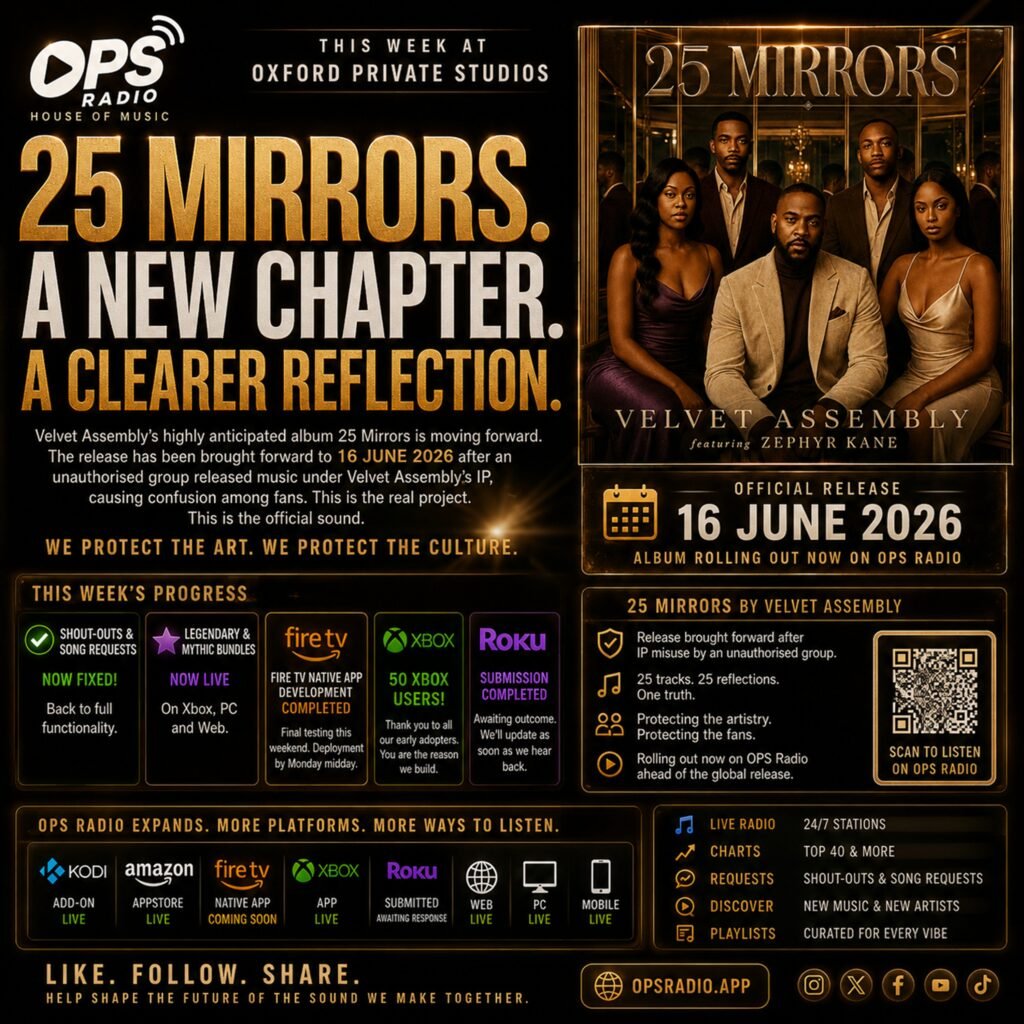
This week alone has seen major developments across multiple fronts. Interactive systems inside OPS Radio have now received stability fixes following ongoing listener feedback. Premium ecosystem bundles have rolled out across Xbox, PC, and web. Native Fire TV application development has now been completed and moved into final testing stages ahead of deployment. The company has also accelerated one of its biggest upcoming music releases following intellectual property concerns involving Velvet Assembly’s fan base. At the same time, Roku submission processes remain active, television ecosystem expansion continues behind the scenes, and OPS Radio itself continues growing into a platform increasingly shaped by direct listener engagement rather than traditional industry gatekeeping.
For Oxford Private Studios, these developments are not isolated product announcements. Internally, they form part of a much larger shift in philosophy. Increasingly, the company appears less interested in depending entirely on traditional music industry infrastructure and more interested in building systems capable of carrying its own catalogue directly to audiences across every major screen environment where modern listeners now consume media.
SHOUT-OUTS AND SONG REQUEST SYSTEMS NOW FIXED
After several weeks of listener feedback and ongoing technical investigation, Oxford Private Studios confirmed this week that fixes have now been rolled out for the OPS Radio shout-out and song request systems.
The issue had affected parts of the platform’s interactive experience across multiple environments, creating inconsistent behaviour for users attempting to engage directly with stations and live listener features.
According to the company, the rollout restores expected functionality across supported ecosystems and represents another important stage in stabilising the broader OPS Radio infrastructure as usage continues to expand across devices.
Internally, teams appear increasingly focused on ensuring OPS Radio develops as more than a passive listening environment. Listener participation systems such as shout-outs, requests, engagement loops, and station interaction are being treated as core parts of the ecosystem rather than optional add-ons.
The company says listener reports continue to play a critical role in identifying weaknesses during the current growth phase and has again encouraged users to continue submitting feedback through the official OPS Radio contact systems.
OPS LEGENDARY AND OPS MYTHIC BUNDLES ROLL OUT ACROSS XBOX, PC, AND WEB
This week also saw the rollout of the OPS Legendary Bundle and OPS Mythic Bundle across Xbox, PC, and web ecosystems.
While Oxford Private Studios has not yet publicly detailed every component included within the bundles, the rollout signals a growing emphasis on premium ecosystem identity and deeper audience integration across the wider OPS Radio environment.
Internally, the move appears connected to a broader effort to strengthen continuity between platforms so that listeners moving between Xbox, desktop, browser, and television ecosystems increasingly experience OPS Radio as a unified environment rather than separate disconnected products.
The bundles also reinforce another trend becoming increasingly visible inside OPS development strategy: the company is placing growing importance on ecosystem retention rather than isolated streams or temporary engagement spikes.
In practice, that means building systems that encourage audiences not merely to listen once, but to remain connected continuously across devices, stations, releases, and community interactions.
FIRE TV APPLICATION DEVELOPMENT COMPLETED
Oxford Private Studios also confirmed this week that native Fire TV application development has now officially been completed.
Final testing is expected to continue throughout the weekend ahead of a planned deployment target scheduled for Monday midday, assuming no critical issues emerge during final quality assurance checks.
The Fire TV expansion represents another major milestone in the company’s increasingly aggressive push into television ecosystems and connected home entertainment environments.
OPS Radio now operates across:
• web
• Android
• Xbox
• Kodi
• Amazon-supported Android ecosystems
• PC environments
And with Fire TV now nearing deployment, the company continues moving steadily toward its wider goal of creating what executives increasingly describe internally as a “screen-independent music ecosystem.”
That phrase matters.
Historically, many independent music projects have remained dependent on browsers, smartphones, or third-party algorithmic platforms for survival. OPS Radio’s current direction suggests Oxford Private Studios is attempting something more ambitious: an ecosystem capable of following listeners seamlessly between televisions, consoles, phones, desktops, and connected-device environments without losing platform identity or audience continuity.
The strategy also reflects wider changes happening across media consumption globally, where living-room environments increasingly shape how audiences discover music, podcasts, video content, and digital entertainment.
VELVET ASSEMBLY’S 25 MIRRORS RELEASE BROUGHT FORWARD FOLLOWING FAN CONFUSION
One of the most significant creative developments this week concerns Velvet Assembly and the group’s upcoming project 25 Mirrors.
Oxford Private Studios confirmed that the album’s release timeline has now been accelerated, with material from the project already beginning to roll out through OPS Radio ahead of its wider launch.
The album is now scheduled for release on 16 June 2026 across most platforms.
Originally, the project had been expected to arrive much later in the year, with November previously targeted as the intended release window.
However, Oxford Private Studios says the schedule was revised after another group allegedly began releasing music while presenting themselves under Velvet Assembly’s intellectual property and identity, creating confusion within sections of the fan base.
The company says the decision to accelerate the release was made in order to protect the integrity of the official rollout and establish clear separation between authorised material and unauthorised activity circulating around the Velvet Assembly name.
Internally, 25 Mirrors is reportedly being treated as one of the company’s more strategically important music releases currently in development.
The project also represents another example of why Oxford Private Studios increasingly believes platform ownership matters. The company argues that controlling distribution environments and listener ecosystems gives independent creatives greater protection when confusion, impersonation, or platform instability emerge around their work.
ROKU SUBMISSION REMAINS UNDER REVIEW
Oxford Private Studios also confirmed this week that its Roku submission process has now been fully completed.
At present, the company says it remains in a waiting phase pending either approval, rejection, or amendment requests from Roku.
Should corrections or platform-specific modifications be required, OPS says further refinement work will continue until the application reaches the standard required for release.
The Roku process forms part of a much wider expansion strategy that increasingly prioritises television-first listening environments.
For OPS Radio, television integration is no longer being treated as experimental.
Kodi is now live.
Amazon ecosystems are live.
Xbox continues expanding.
Fire TV is nearing deployment.
Roku remains under review.
Collectively, those developments paint a clear picture of the company’s direction: OPS Radio intends to become present wherever audiences already consume entertainment.
OPS RADIO REACHES 50 XBOX USERS
Oxford Private Studios also announced this week that OPS Radio has now officially reached 50 Xbox users.
While relatively small in comparison with large-scale commercial platforms, the company described the milestone as highly significant internally because it reflects early adoption during the ecosystem’s formative growth stage.
Executives say the milestone represents more than a number.
It represents proof of movement.
Proof that listeners are beginning to carry OPS Radio into console environments.
Proof that the platform can function beyond mobile devices.
And proof that the ecosystem itself is beginning to establish a real audience footprint across multiple environments simultaneously.
The company used the milestone announcement to thank early adopters directly, describing them as critical participants helping shape the future direction of the platform.
OPS also confirmed that listeners will continue receiving regular updates regarding newly released music across stations and channels moving forward.
Importantly, the company also signalled that audience demand may increasingly influence release scheduling itself.
“If there’s music listeners want earlier, we can adapt priorities,” the company said. “Some projects can move forward while others move back depending on audience demand and platform momentum.”
That approach reflects a growing shift toward participatory audience culture inside OPS Radio, where listeners are increasingly being treated not simply as consumers, but as active contributors helping shape programming direction and release focus.
WHY OXFORD PRIVATE STUDIOS IS BUILDING ITS OWN ECOSYSTEM
Behind every platform launch, technical rollout, and ecosystem expansion sits a much larger strategic reality currently reshaping Oxford Private Studios internally.
The company says growing dissatisfaction with traditional distribution structures has increasingly pushed OPS toward building its own infrastructure rather than depending entirely on external systems.
Executives within the company argue that many creatives struggle to achieve sustained visibility under current algorithm-driven discovery systems, regardless of quality, consistency, or artistic effort.
According to OPS, the issue is no longer simply about getting music uploaded onto platforms.
It is about whether audiences meaningfully encounter that music afterward.
The company increasingly believes independent creatives require:
• visibility infrastructure
• stable discovery environments
• audience continuity
• direct engagement systems
• reliable platform access
• ecosystem ownership
OPS Radio is therefore being positioned not merely as a radio application, but as a long-term foundation for creative sustainability.
The company says one of its core objectives is to create an environment where OPS creatives are not buried beneath industrial-scale recommendation systems and short-term algorithmic trends.
Instead, the goal is to build a dedicated ecosystem where listeners can:
• discover artists directly
• support releases
• influence programming
• engage with stations
• request music
• follow charts
• remain connected continuously with the catalogue
Oxford Private Studios says the wider ambition remains centered around giving creatives not only a platform to speak through, but a realistic pathway toward long-term sustainability and genuine audience ownership.
THE WORKLOAD CONTINUES TO EXPAND
Internally, the amount of work now being carried across Oxford Private Studios appears substantial.
This week alone has involved:
• television ecosystem deployment
• Fire TV completion
• Roku submission management
• interactive feature fixes
• Xbox ecosystem expansion
• premium bundle rollouts
• platform testing
• artist release restructuring
• radio scheduling
• infrastructure refinement
• catalogue management
• content deployment planning
At the same time, broader development continues across:
• OPS Christian Broadcast
• OPS Gospel integrations
• future television ecosystem support
• listener analytics systems
• chart infrastructure
• premium engagement systems
• artist discovery tools
• content distribution frameworks
The result is a company increasingly operating at the intersection of media, music, platform engineering, and audience infrastructure.
Oxford Private Studios says the work remains ongoing.
There are still systems being refined.
There are still platforms being entered.
There are still audiences being built.
But the direction is becoming increasingly unmistakable.
OPS Radio is no longer simply broadcasting music.
It is building an ecosystem around how independent music survives, travels, and grows in a fragmented digital era.
OPS Radio.
House of Music.

